#What price should I set for my domain?
 FAQ: This is the help centre of ELITEDOMAINS. We are a domain provider that lets you manage domains simply and smartly. We also run a domain catcher, a domain marketplace and attractive landing pages to sell domains automatically.
Contents
The price of your domain is determined mainly by length, keyword, extension and the visitors it already brings. Compare similar sales, orient yourself towards companies that want to use the domain themselves, and then set a fixed price for buy now. With price negotiation, buyers show you what they would pay, and the sale page statistics tell you whether your price is too high.
#1) What determines the value of a domain?
| Criterion | Raises the value | Lowers the value |
|---|---|---|
| Length | short, easy to remember and type | long, made of several words |
| Spelling | one word in the singular | hyphens, digits, umlauts, plural |
| Keyword | high search volume and high cost per click (CPC) | term hardly anyone searches for |
| Industry | industries with a lot of advertising, such as insurance, loans or travel | niches with little turnover |
| Extension | .de for the German market, .com internationally, premium domains | rare extensions |
| Brand | sounds good, suitable as a company name | reminds of someone else's brand |
| Visitors and links | brings visitors via links, as a backlink domain | no visitors, no links |
Google Ads' Keyword Planner shows you a keyword's search volume and cost per click. A high cost per click means that companies pay a lot for visitors with this term, and these companies also buy domains.
If a domain contains someone else's brand or a typo of it, it has no sales value but a legal risk. What can happen then is described under Legal problems with the domain.
#2) How do I find comparable prices?
In the end, a domain is worth what a buyer pays for it. You find achieved prices in databases such as NameBio and in the sales reports of large marketplaces such as Sedo. On the marketplace you see the prices at which similar domains are currently offered. These are the sellers' asking prices; sold domains disappear there.
Automatic valuations, for example from EstiBot, only give a rough indication and are often off for .de domains. So rather rely on real sales of similar domains.
Who buys also matters: a company that wants to use the domain itself usually pays many times what a domain trader pays who wants to resell it. So align your fixed price with these end customers.
#3) Fixed price or price on request?
With a fixed price and the purchase option buy now, an interested party buys immediately. This is the fastest way to a sale, because the buyer doesn't have to negotiate. Without buy now, your price is only a non-binding asking price, and you negotiate every price negotiation or contact request yourself.
For most domains a fixed price pays off, ideally together with price negotiation: impulse buyers buy immediately, everyone else offers you a price. Contact requests alone suit top domains with a high price, where you want to know every buyer. A fixed price starts at €99.
#4) How do I find the right price with price offers?
If you choose the purchase option price negotiation for the sale page, interested parties tell you their price. An offer is always below your fixed price and at least €99. You answer it with an acceptance or a counteroffer. If many offers come in at the same level, you know the price the market pays.
With an offer link you give individual buyers their own price without changing the price of the sale page.
#5) Net or gross, and what do I keep?
All prices on ELITEDOMAINS are net, i.e. without VAT. With buy now, the sales commission is deducted from the purchase price, so factor it into your price. How VAT is calculated on the sale is explained in the article on VAT for sellers.
#6) How do I recognise that my price doesn't fit?
The sale page statistics show you how many visitors a domain has. Collect figures for a few weeks before you change the price. If the domain has visitors but no requests, or only price offers far below your price, the price is probably too high. If it hardly has any visitors, it is more likely a question of demand than of price. Then a portfolio or a bundle helps more than a lower price.
#7) How do I set prices for many domains?
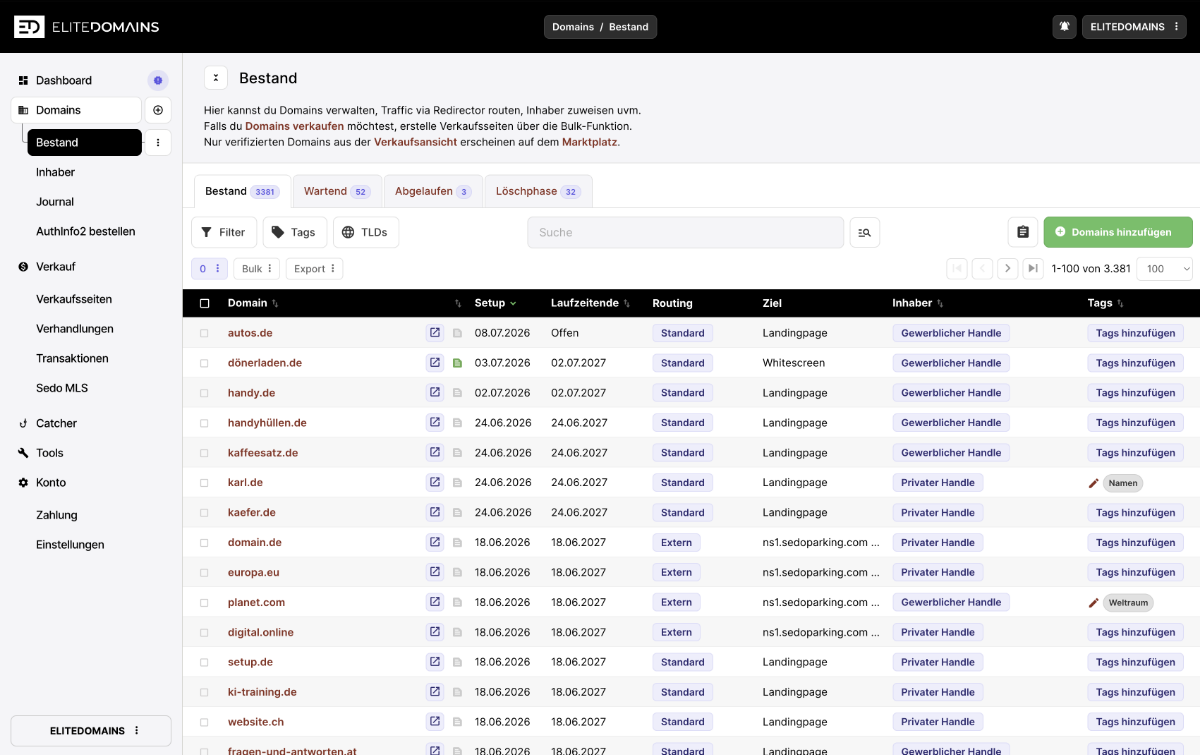
Divide your portfolio into groups, for example top domains, good domains and simple domains, and give each group a price. With tags and filters you assign the domains and change the prices for all of them at once under „Verkauf“ → „Verkaufsseiten“ → „Bulk“ → „Verkaufsseiten bearbeiten“ (Sale → Sale pages → Bulk → Edit sale pages).
Instead of a fixed amount you can also choose „Neuer Preis in %“ (new price in %) there: 80 lowers all prices by 20%, 120 raises them by 20%. With „Neuen Preis runden“ (round new price) the new prices land on round €100, 50, 10, 5 or 1. This way you test a new price for a whole group. You sell weaker domains together as a bundle, and you show your best ones together in a portfolio.
- What are backlink domains (expired traffic domains)?
- How do I sell several domains as a bundle?
- What should I know before buying a domain?
- How does buy now with escrow service work?
- How do contact requests on sale pages work?
- How do I create a sale page for my domain?
- How do I verify my domain with a TXT record?
- How can I sell domains with ELITEDOMAINS?
- Which templates are there for sale pages?
- How do negotiations work when selling a domain?
- How does my domain get onto the marketplace?
- What is the Sedo MLS network?
- What are portfolios and how do I create one?
- How do I synchronise domains with Sedo (MLS sync)?
- Which statistics do the sale pages show?
- How is VAT calculated for sellers?
- Bought a domain – what now? How the transfer works
- How do I verify external domains for sale pages?
Last updated on 28/11/2026 at 21:13
Let's go!
Create your account now
Register your next domain with us and compare us with your current provider. The account is free.
Join for free now