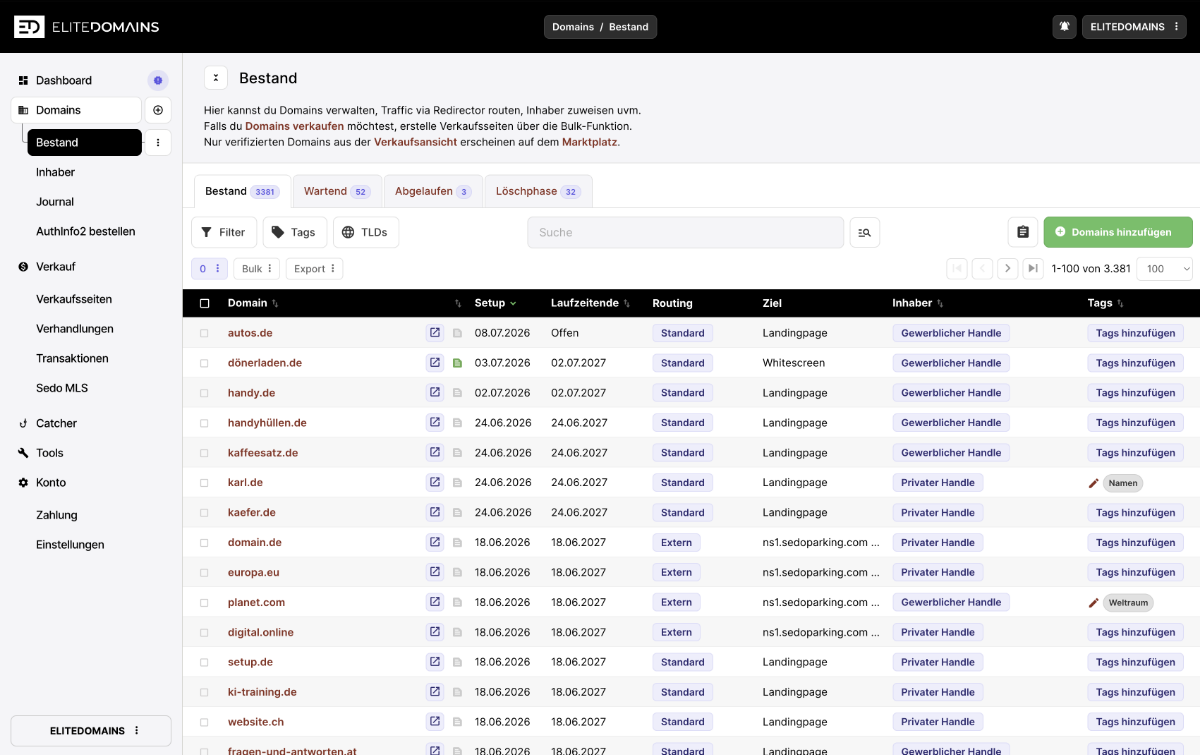
#What is the life cycle of domains?
 FAQ: This is the help centre of ELITEDOMAINS. We are a domain provider that lets you manage domains simply and smartly. We also run a domain catcher, a domain marketplace and attractive landing pages to sell domains automatically.
Contents
After registration, every domain goes through fixed phases: it is active until its term ends and is then renewed or deleted. After deletion, most extensions have a deletion phase in which you can get it back by RESTORE before it becomes free again and anyone can register it. How long the phases last and which ones exist depends on the extension: for .com, for example, the end of the term is followed by an expired phase of around 42 days; from deletion there are around 30 days for a RESTORE, after which the domain becomes free again after a short lock period.
#1) Which phases does a domain go through?
From registration to release, these are the phases:
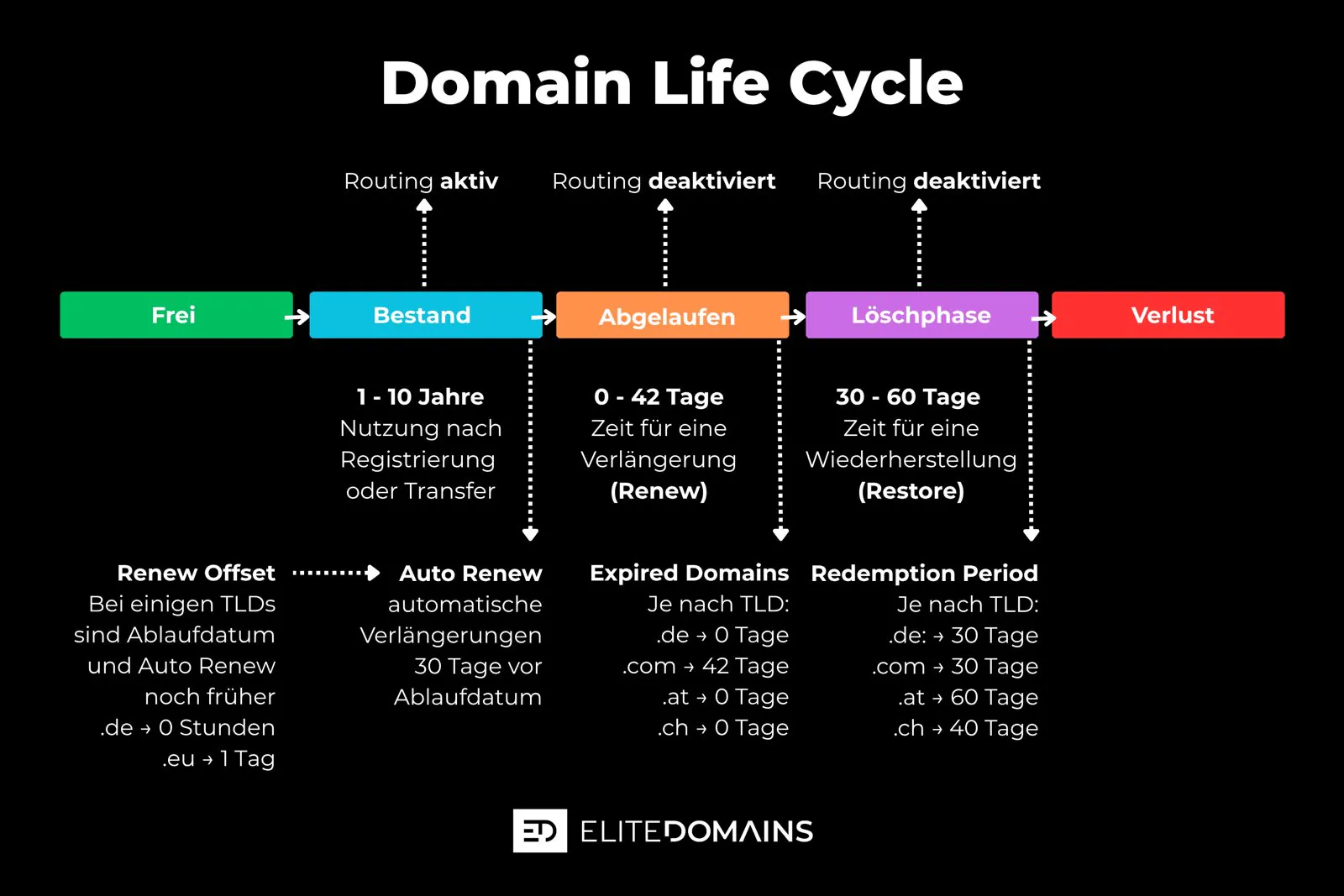
- Registration: You register the domain for a term of one to ten years, depending on the extension.
- Active: The domain runs normally. We renew it automatically before the end of the term, unless you have switched on AutoExpire.
- Expired phase: Some extensions such as .com have a grace period after the end of the term. In it you can still reactivate the domain at the regular renewal price.
- Deletion phase: The domain is deleted but still reserved. You only get it back by RESTORE. For .de this phase is called the Redemption Grace Period (RGP); for other extensions, quarantine or pendingDelete.
- Release: After the deletion phase, the domain is finally deleted at the registry. From now on anyone can register it again.
#2) How long do the phases last per extension?
Not every extension has every phase, and the durations differ:
| Extension | Expired phase | Deletion phase | Register again after release |
|---|---|---|---|
| .de | none | 30 days RGP at DENIC | .de catcher |
| .at | none | 60 days pendingDelete at nic.at | .at catcher |
| .ch and .li | none | 40 days quarantine at SWITCH | .ch and .li catcher |
| .eu | none | 40 days quarantine at EURid | .eu catcher, closed beta |
| .com | around 42 days | around 30 days, then a short lock period until release | domain search |
For other extensions, support in the chat tells you the deadlines. The prices for renewal and RESTORE per extension are in the price overview.
#3) What can I do in which phase?
The earlier you act, the cheaper it gets:
| Phase | What you can do |
|---|---|
| Active | Let automatic renewal run or delete at the end of the term via AutoExpire |
| Expired phase | Reactivate the domain at the regular renewal price |
| Deletion phase | Restore the domain by RESTORE; for .de also with an AuthInfo2 code |
| Release | Have .de, .at, .ch, .li and .eu domains registered again at the moment they become free with the extension's catcher (see table above); you find candidates beforehand in the droplist. You register all other extensions such as .com normally via the domain search after release |
How to get a domain back in an emergency is explained in the article Rescuing domains.
#4) What is different for .de domains?
.de domains have no expired phase: a deleted domain usually goes straight into the 30-day RGP. RGP domains are released every night between 2:00 and 4:00 German time. However, DENIC has exceptions in which there is no RGP or the life cycle runs differently:
- FAILED: If the name servers of a newly registered domain are still faulty after 30 days, DENIC deletes it immediately. The domain does not enter the RGP and cannot be restored by RESTORE. So correct a FAILED domain in good time.
- Waiver of the RGP: The last holder can waive the RGP in writing; the domain then becomes free immediately. More under RGP exceptions.
- DISPUTE: If a domain has a DISPUTE entry, it does not enter the RGP after deletion but goes straight to the holder of the DISPUTE.
- TRANSIT: If no provider manages the domain any more, DENIC takes it over into TRANSIT.
- Quarantine: If the holder verification fails, DENIC switches off the domain. If the verification does not happen within 90 days, it deletes the domain without RGP. The .de catcher also catches such domains. This has nothing to do with the quarantine at SWITCH and EURid, which is a deletion phase.
The domain monitor reports changes to other people's .de domains, for example the change into the RGP.
- What is the AuthCode (AuthInfo) for a domain transfer?
- How can I delete domains or let them expire?
- Which domain contacts (handles) do domains have?
- What is the HOLD status for domains?
- How do I manage domains with tags, filters and notes?
- What are premium domains and why are they more expensive?
- Moving a domain: AuthCode at IONOS, Strato & co.
- How can I register domains?
- How can I rescue a .de domain?
- What is a RESTORE order for deleted domains?
- What is the Redemption Grace Period (RGP) for .de domains?
- What is the difference between ccTLD, gTLD and newTLD?
- Moving and transferring a domain: transfer guide
- Why do I have to confirm a domain transfer?
- How does the transfer service for domains work?
Last updated on 28/11/2026 at 21:07
Let's go!
Create your account now
Register your next domain with us and compare us with your current provider. The account is free.
Join for free now