#Why do holder details have to be verified?
 FAQ: This is the help centre of ELITEDOMAINS. We are a domain provider that lets you manage domains simply and smartly. We also run a domain catcher, a domain marketplace and attractive landing pages to sell domains automatically.
Contents
Many registries require verification of holder details: either on registration, on a transfer or because of a risk classification of the records. With international extensions the holder usually confirms a link by email for this; with .de and .at domains you upload a document under the NIS2 directive. The reasons are the registry's regulations or national cybersecurity laws.
#1) What is a Standardized Form of Authorization (FOA)?
With many international extensions, holder verification is necessary on registration and transfer of the domain. For this, the holder receives an email from the ICANN member in which they must confirm the existence of the email address and of the holder with one click. This ICANN procedure is called "Standardized Form of Authorization" (FOA) and has also been adopted by some other national registries.
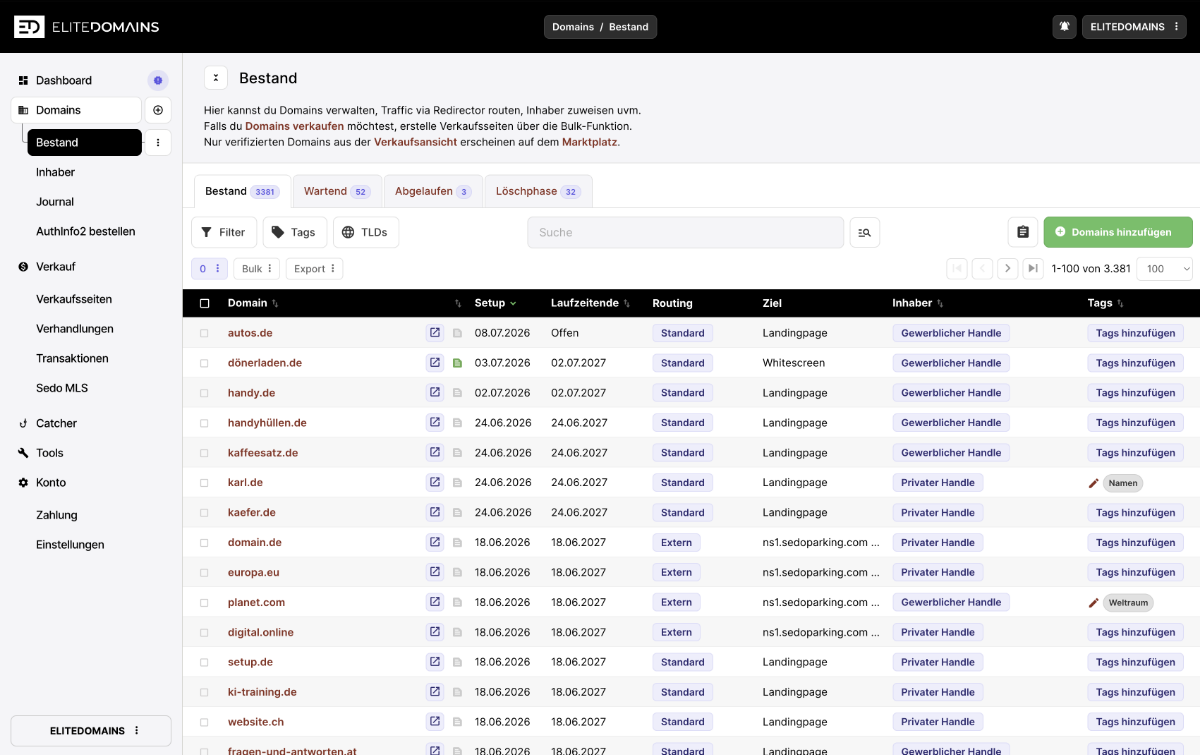
If a registration or a transfer is waiting for this confirmation, the domain is listed in your domain portfolio under „Wartend“ (pending) with the status „Inhaber verifizieren“ (verify holder) or „Transfer verifizieren“ (verify transfer). The holder has received an email with a verification link for this. With a transfer, the old and the new holder confirm; more under confirming a transfer. Some extensions require pre-validation before registration; you then receive an email with instructions.
#2) How does holder verification work for .at domains?
nic.at also checks holder details under NIS2, on a case-by-case basis. You then upload a document with name and address, usually within 21 days. Proofs, deadlines and consequences are under holder verification for .at domains.
#3) What is DENIC's holder verification under NIS2?
From April 2026, the registry DENIC introduced holder verification for suspicious holders. It is based on the NIS2 directive (German implementing law, in German) for critical infrastructure to strengthen cybersecurity. DENIC's verification procedure is unfortunately complicated, so here are some questions and answers about DENIC's NIS2 holder verification:
#How does DENIC carry out the risk assessment?
Every domain is analysed by DENIC at the moment it is used. The risk assessment is carried out with DENIC's own AI. Always at the moment the domain is used, for example on an update or a transfer.
#Which data does DENIC use for the risk assessment?
DENIC uses the name, the address and all metadata about the domain (internal and external sources). This data is analysed with the AI for the risk assessment and classified by risk in a traffic light system. Green is OK, yellow needs holder verification and red goes into quarantine immediately. For context: at launch we had 95% green, 5% yellow and 0% red records.
#What is a suspicious holder (yellow light)?
DENIC has doubts about the address or existence of the holder here. From DENIC's request there are 30 days to prove the holder's existence with documents at the DENIC member. If this doesn't happen within the deadline, the domain goes into quarantine and DENIC deactivates the routing. At DENIC this status is called verification required.
#What happens in quarantine (red light)?
With a red light, DENIC puts the domain into quarantine immediately, without the 30-day deadline beforehand. With a yellow light, quarantine follows when the 30 days have passed. In quarantine, DENIC deactivates the routing, and the holder has 90 days from the start of quarantine to verify the holder details. Whether one of your domains is affected you see in your domain portfolio under „Wartend“ (pending). If this doesn't happen within the deadline, DENIC deletes the domain without a deletion phase (RGP). At DENIC this status is called serverHold.
#Who carries out the verification?
The verification is carried out by the DENIC member. With us you are informed about suspicious domains by email and can upload verification documents of your choice to the holder of the domain at any time.
#What exactly do I need to verify?
The name and/or the address must always be verified. This can be done with different documents.
#Can I verify a person with a company document?
With us this is possible, because it is always the name or the address that must be verified, not the type of contact.
#Is there a new check as soon as I update the suspicious holder?
No, DENIC only ever checks a holder when this holder is used. DENIC wants to prevent people from testing records until the AI accepts the holder details. Here you find an overview of all DENIC orders in which the holder is used.
#Can I transfer a "suspicious domain" to another holder?
Yes, but this doesn't help with verification. With a new holder, the domain still has to be verified with a corresponding deadline, unless this other holder is already verified.
#Can I update the name servers of a "suspicious domain"?
Yes.
#Can I transfer the "suspicious domain" to another provider?
Yes.
#What happens if I delete the suspicious domain?
After deletion there is no longer any reason to verify the respective holder for the time being. So the problem is settled. With a new domain with the same holder, however, there is a high probability that the holder will have to be verified again.
- How do I set up an account at ELITEDOMAINS?
- How does the API work?
- Why are .de domains so cheap at ELITEDOMAINS?
- How do I get a demo access?
- Where can I create email addresses for my domain?
- What is an emergency contact and what do I need it for?
- How do I set up an MCP server for ELITEDOMAINS?
- Which domain extensions does ELITEDOMAINS offer?
- What is the difference between Webmaster and Domainer?
- How does holder verification work for .at domains?
- Where do I find web space for my domain?
Last updated on 28/11/2026 at 21:07
Let's go!
Create your account now
Register your next domain with us and compare us with your current provider. The account is free.
Join for free now